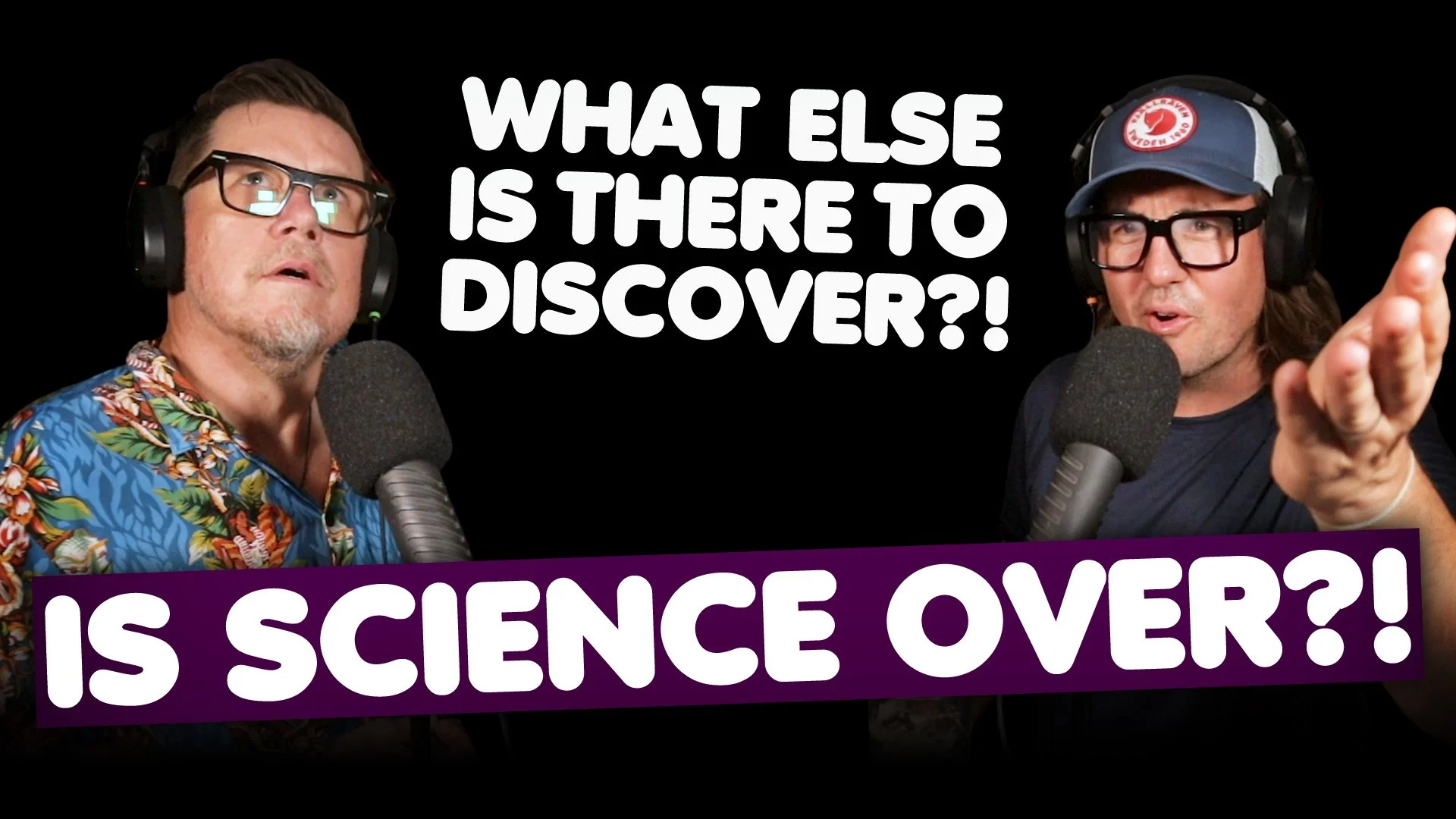
It’s the end of the science as we know it! And I feel fine! But seriously though, is it? As a global community, we are investing 10 times more money and resources into scientific research than we did in the 1950s, yet the number of groundbreaking discoveries is dwindling.
We’ve gone to the moon. We’ve discovered massive black holes. We’ve split the atom and peered through high-resolution microscopes to observe those tiny little quarks. Sure, we’re still making advancements, but a lot of science these days is refining past discoveries. We’re not really uncovering anything new. In fact, most of the Nobel Prizes awarded since the 1990s have been awarded for scientific work that went on in previous decades.
So is scientific pursuit just slowing down? Or, are we nearing the end of scientific discovery altogether?
The 19th century witnessed some significant claims about science coming to a halt, which is pretty ridiculous to think about, considering what we know now. But back then, it was quite the hype, with science bigwigs like Albert Michelson (he measured the speed of light and became the first American to win the Nobel prize in science) declaring that physics was on the verge of reaching its absolute terminus, with only minor refinements remaining.
In 1878, Munich physics professor, Philipp von Jolly, who measured the acceleration due to gravity with precision weights, advised Max Planck against going into physics. He said that in this field “almost everything is already discovered and all that remains is to fill a few unimportant holes." Thankfully Planck ignored this advice because he went on to discover quantum mechanics, a pretty huge reversal of classical Newtonian physics.
In more recent decades, contemporary author John Horgan, proposed in his book, "The End of Science," that the era of groundbreaking discoveries might be making its curtain call. This doesn’t make scientific inquiry worthless altogether, but he made the argument that modern advancements will be made in small increments, unlike the past golden eras of scientific discovery.
Horgan’s book caused quite a stir, with people declaring it “un-American” and “anti-science” - but maybe he was onto something. Could we eventually know everything there is to know? Or perhaps, while it may seem science is reaching the edge of absolute understanding, we might stumble across some new mystery that changes the game altogether.
With a finite number of atoms in the universe, it might seem logical to conclude that humanity will eventually reach the end of discovery altogether, but is it arrogant or naive to say this with absolute certainty? We can’t possibly know for sure.
Perhaps up until this point, scientists have picked the low-hanging fruit and exhausted all of the scientific discoveries that were ripe for choosing. Einstein, Darwin and Newton, from our modern perspective, had the obvious stuff staring them in the face.
If you ask Rod, we just have to look harder and look differently. Just because we’ve made so many big leaps in the past doesn’t necessarily mean there is nothing left to discover. It seems like a big call to say that one day we will know everything there is to know about everything.
On the other hand, Will has a gut feeling that science can eventually get to the end. If the steady decrease in scientific discoveries continues, the trajectory will one day lead us to a finite end where, finally, we will know the whole of science.
SOURCES:
Was I Wrong about “The End of Science”? By John Horgan
Lord Kelvin and the End of Physics, Which He Never Predicted
Albert Michelson, notes at the Inauguration of the Ryerson Physics Laboratory
Everything That Can Be Invented Has Been Invented by David J Katz
Papers and patents are becoming less disruptive over time by Michael Park, Erin Leahey and Russel J Funk in Nature
Are we witnessing the end of science? In The Guardian
-
[00:00:00] Will: How fast is the process of science? Are we discovering more things? Are we discovering less things? First point, we are spending at least 10 times the amount inflation adjusted as they were spending in the 1950s. So there's way, way more people involved, but we're discovering less. So science actually is slowing down and some people might say that's an indication that we're getting towards the end. if you knew there was a limited amount of treasure in a house, you know, it's like an Easter egg hunt Those Easter eggs are called science nuggets.
[00:00:28] The first ones are super easy to find. Because there's 50 around and your chances of running across one are way higher. But the last one takes longer. Inherently, they take longer and longer to get. But what you can work from that is if there's a limited number of things to discover, they will take longer to find the last one.
[00:00:44] If we were to get towards the end of science, one thing that would happen before the end is you slow down.
[00:00:49] Rod: Yeah, I agree.
[00:00:49] Will: You slow down in your number of discoveries.
[00:00:51] Rod: I agree. I agree.
[00:00:52] Will: So that could be evidence that we're getting towards the end.
[00:01:00] Rod: So there's a story that's been around for probably, seems like about 150 years. In the mid to late 1800s, allegedly the head of the U. S. Patent Office quit his job and recommended that the office be shut down because there's basically nothing left to invent.
[00:01:13] Will: Nothing left. 1850! We got trains! What more could we want?
[00:01:16] Rod: Well, the latest quote I saw, they said, oh, maybe it was 1899, but it was always between 1850 and 1899, he said, fuck it, there's nothing left. No point inventing, no point having patent officers. Now I first came across this in the late 90s, like 1990s. I read a book by a guy called John Horgan, Science Journalist, and the book's called The End of Science: facing the limits of knowledge in the twilight of the scientific age, which is a big call.
[00:01:38] Will: What's his argument? I mean, I heard the title, the what's he arguing?
[00:01:42] Rod: He's got things like science may be reaching a point, this is in 1996, where fundamental questions have been answered and the era of groundbreaking discoveries is coming to a close.
[00:01:52] He uses the term, I think he actually coined the term ironic science, to describe situations where the pursuit of knowledge ultimately leads to the realization of its own limitations. He also argues that things like funding pressures, academic competition, institutional biases, blah, blah, blah, are impeding or were impeding scientific progress and growth, duh.
[00:02:11] But he's not saying Scientific inquiry is pointless. He's just saying from this point forward, it's pretty much going to be mundane. It's just going to be small increments and that this notion that the limits of science are infinite, is not actually true, that's his theory. And he uses biology examples, psychology examples, chemistry examples, he goes through a whole bunch of stuff. And I read it and thought, I don't buy it, buddy. I was a fledgling PhD student and I was like, I'm fucking smart. And then it was presented in a seminar by another student and a whole bunch of the more hippie end of our group, they just sat there going, Whoa, he's right. It's all over. Are we done with science? Is it all over?
[00:02:46] Will: Well, that's the question we're going to ask today.
[00:02:54] Welcome to the wholesome show, the podcast that ponders when we'll get to the end of the whole of science. I'm Will Grant.
[00:03:02] Rod: I'm Rod Lamberts, it took me a moment to remember. I'm already blown away, I'm already blown away by this.
[00:03:06] Will: So today we're exploring this concept. Where, when, will we ever get to the end of science? Or have we already? Can we, and do we, know it all? Alright, I got some thoughts.
[00:03:20] Rod: Well, Horgan wasn't first, we know that.
[00:03:22] Will: Yeah, Horgan wasn't the first, and I think it's interesting. So, so, I found a couple of examples of people saying it. And I'm going to come back to your patent guy in a second.
[00:03:29] Yeah! Because you know, it's interesting. There's a pattern here. I found a whole bunch of people, they were supposedly Way way before science was invented, there was people saying, Oh, we're at the end of knowledge. Like, like I saw on the internet, people like in ancient Egypt were like, yeah, we know everything there is to know.
[00:03:46] Rod: The pharaohs are ultimate. Bang your family.
[00:03:49] Will: And maybe it's something like that, but then there's you know, in the middle ages, there's a lot of religious scholars, the scholastics who are like yeah, we know everything there is to know. It's all just interpretations of God's mind, but that's by the by. You know, once we've developed modern science where people are going, no, you go out and test stuff and you go and look at the universe and you go, all right, we'll keep looking at the universe. We'll find some new stuff. Then it becomes interesting. If someone says. Okay, now we've got all the knowledge.
[00:04:12] Rod: Found it. I went looking and there's nothing left to look for.
[00:04:15] Will: So you said there was the patent guy in 1850.
[00:04:18] Rod: Supposedly.
[00:04:19] Will: There's a couple of patent guys. The first one I found was a physics professor in Munich. Philipp von Jolly. He was a physicist. He was the one that measured the acceleration due to gravity precisely.
[00:04:28] Rod: So he did a lot of jumping off buildings and screaming with a stopwatch
[00:04:31] Will: yes, it's stopwatch work, advanced stopwatch work. But in 1878, he said to Max Planck, ah, look, don't bother going into physics. Go do something else. 'cause we've already discovered everything, everything else is just a few unimportant holes.
[00:04:44] Rod: So if Planck had listened, germany would have no institutes for anything. Like seriously, there's nothing in Germany not called the Max Planck Institute of, so what if he hadn't gone into research and physics?
[00:04:54] Will: I think that wouldn't have been a problem. Like let's look at Max Planck's actual contributions to science discovery of quantum mechanics as perhaps more important than the centres that are named after him. So he was obviously wrong because he said it to Max Planck and Max Planck went and did some
[00:05:09] Rod: bragging rights though. So I was having a chat with Max Planck and I said, don't do a PhD.
[00:05:13] Will: He wasn't so famous at the time.
[00:05:15] Rod: Not as famous as Kurt Cobain was when I met him. Carry on.
[00:05:18] Will: Jesus. He is very hard to keep on topic.
[00:05:21] Rod: I was ready to keep going. The other one made a big deal out of it.
[00:05:24] Will: You know, there's, but there's a couple of other people, and the most famous one of someone saying this was Lord Kelvin. Measured absolute zero or the first person to theoretically get to not measure it, but get to what the temperature would be for absolute zero. He worked on like the undersea telegraph cable. Like in, in 1880, 1890, it was like top of the game in physics. Actually. I remember there was this thing where Einstein's special relativity came out like 1905 or something like that.
[00:05:49] And a bunch of people said, Oh, look, it is too hard for people to understand. There's only like six people can understand this in the world. Einstein's not one of them. Lord Kelvin is one of them that can understand. So he was considered smart. They were showing how cool it was.
[00:06:01] Rod: There are things Einstein didn't understand, like how to be in a civilized relationship with a lady. Not his gift.
[00:06:07] Will: Was that not his gift?
[00:06:08] Rod: Not his gift. Einstein reputedly was less than a champion for the ladies. So, you know, some things even Einstein can't do or understand.
[00:06:15] Will: But Lord Kelvin apparently said in 1900 in an address to the British Association for the Advancement of Science, There is nothing new to be discovered in physics now. All that remains is more and more precise measurement.
[00:06:26] Rod: Was it the sixth decimal place call? Allegedly.
[00:06:29] Will: Kelvin didn't actually say this. He's famous for saying this. But there was another guy. Was it Albert Michelson? First American to win the Nobel prize. He did say this, something roughly to the same effect in 1894... while it's never safe to affirm that the future of physical science has no marvels in store, it seems probable that most of the grand underlying principles have been firmly established and that further advances are to be sought chiefly in the rigorous application of these principles and to be looked for in the sixth place of decimals.
[00:06:56] Rod: Isn't that exciting though? If you really want to go far in physics it's beyond weeds. It's down in the protozoa, plant bits.
[00:07:03] Will: So it wasn't Kelvin that said it, but there was someone around there in 1894 and similarly, you get your patent officer guy. No. He didn't say that.
[00:07:12] Rod: No. Good story though.
[00:07:13] Will: In fact, he said pretty much exactly the fucking opposite.
[00:07:16] Rod: Open more patent offices. Wait, the guy who didn't exist, who didn't say the thing, actually said something else?
[00:07:21] Will: No, his name was Charles Holland Duell. And he said, he apparently had said everything that can be invented has been invented, but it was totally fake news. In 1992, he said, it's amazing. All previous advances in the various lines of invention will appear totally insignificant when compared to the next century. Like he's like, shit's going to get wild.
[00:07:38] Rod: Well, sure. I've invented a new wheel for a horse cart. Doesn't sound as exciting now as it did
[00:07:43] Will: Well, all I'm saying, he didn't actually say, We've invented everything. And then you get your modern people. John Horgan. So you read the book.
[00:07:49] Rod: I did.
[00:07:50] Will: Was it big at the time?
[00:07:51] Rod: Yeah, it was certainly noticed, but like, I was in A PhD program in science communication, science faculty.
[00:07:58] Will: cause I was reading the press about this book. There was a bunch of people talking about this and a lot of people, a lot of people were furious. I was looking at some blog posts and letters written into different science magazines. I was looking at comments under a few more recent blogs on it and people are like, this is un American, this is anti science, this is just. They were furious at the idea that someone would argue that we could possibly either be at or come to the end of science.
[00:08:24] Rod: I love it, instilling anger and they still are angry. The anger continues like today with him. Yeah. And he of course has doubled down, but we'll get to that later. It's it intrigues me how mad it makes people. Cause it, to me, it's kind of like people with religions, I won't name any religions, but you get really mad if you pick on some aspect of their religion, they're like, this is the infallible, most amazing thing in the world, you said it isn't, we're all fucking angry with you.
[00:08:45] Will: But you know what, I mean, the thing that, that gets me, I mean, about this question is, Inherently, we Can't know the future and obviously predictions can be silly. You know, if you say whatever's going to happen tomorrow, what is going to happen in a hundred years, but the idea that we could come to the end of science. I get it's a big claim, but it's not an impossible claim.
[00:09:06] Rod: It's not impossible, but it's different to saying, look, humans can only grow so tall and you kind of go. Yeah, I get that. Like a hundred foot tall human, we have reason to think, Yeah, alright, fair enough. That seems a bit crazy. But, We're going to get to the point where we can't discover anything new at all, there's a wacky proposition.
[00:09:19] Will: Okay, I'm hearing a little bit of tone from you. A wacky proposition
[00:09:22] Rod: I'm a toneless man
[00:09:23] Will: the centerpiece of Hogan's argument. He reckons two things: that most of the new knowledge that we're going to be developing, we'll sort of fill in the gaps between the big theories that have been developed already. So we're not going to overturn Einstein, oh, it's unlikely to. We're not going to overturn development of DNA, evolution, these kinds of things, big ideas, and everything that we develop into the future will be filling in the gaps ever more and more detail. So one bit he's saying is the big picture won't change.
[00:09:52] Yes, we'll be doing more. But the second thing is he reckons, okay, maybe if there are remaining mysteries, maybe we'll get to a place where we can't solve them. So it's like, it's just not possible. It's not possible to solve those things. Okay. So that's Horgan's argument. Do you reckon we will get to the end of science?
[00:10:11] Rod: If there are limits to things that the processes of science can find out, I can't argue that's not true. Cause I just don't have any way to say there's no way that can be the case. Oh, you know, like there are things about, you know, meanings of life and people talk about that, all the more esoteric stuff and they say, well, science can't tell you, I can tell you what something is, but not what it means.
[00:10:28] Will: Yeah, sure. That's not science's job
[00:10:30] Rod: But if you're thinking about like, I'm thinking of Richard Dawkins he's quoted as saying, if there is a better way to find things out, science would have found it. And I kind of go, how can you say that for sure? Just because you don't know what the thing that to replace it is doesn't mean it doesn't exist
[00:10:42] Will: but let's call knowledge discovery process, some process of trying to discover new things about the universe. We can call that science or you can call it, you know, the future people on earth, they can call it whatever they want. Fine. I've got no problem there, but a knowledge discovery process. Would we get to a place where we have discovered all there is to know? Yes. Putting to the side things like meaning, like how the universe works, how major things work. Can't we get to a place where potentially
[00:11:07] Rod: I don't think we could say that with confidence. Cause I think of things like, you know, Small animal creatures that exist only in microscopes, they weren't even a thing then they were looked at and they were found. But more to the point, you've got a molecule, you've got an atom and people go, well, the atom is the smallest unit of nature. And you're like, Oh no, it's not. There's something smaller. People go, cool cool. Electron. Smallest thing. Proton. Smallest thing we've got. Oh, hang on. There's something smaller.
[00:11:27] Will: So the idea that we've updated a few times over the last 180 years means we will keep updating for the next 180, 000 years.
[00:11:36] Rod: I'm not saying it means we will, I'm saying I don't think we can be confident that we won't.
[00:11:41] Will: I think we're going to come to a bit of a debate here because I actually in looking at some of these things, I think there's a bit of an argument that maybe we might be coming to the end of science. Or at least we're pointing in that direction. So one thing and this is a great study that came out in Nature last year. They tried to look at, okay how fast is the process of science? Are we discovering more things? Are we discovering less things?
[00:12:03] Rod: Yeah. They analyzed, it's something like 45 million scientific papers. 3. 9 million patents.
[00:12:09] Will: First point, we are spending well, just in America, at least 10 times the amount inflation adjusted as they were spending in the 1950s. So we are spending way, way more. And I would say you compare the number of scientists around the world with the time when Einstein was working or when Newton was working or any of these other luminaries is Orders of magnitude more.
[00:12:32] So there's way, way more people involved, but we're discovering less. Like we are absolutely, there are fewer disruptive big change discoveries every single year as we go. So science actually is slowing down whether we're getting to the end. It's slowing down. And some people might say that's an indication that we're getting towards the end. Like when you run out of big things to discover.
[00:12:56] Rod: Not when you've run out of them, when you haven't discovered any, that's the thing. I'm just like, I don't know that we've run out of them.
[00:13:03] Will: Yeah. Okay. Well, here's the thing. If you knew there was a limited amount of treasure in a house and, you know, it's like an Easter egg hunt.
[00:13:10] Rod: Is it this house?
[00:13:11] Will: Yes. I've hidden some Easter eggs in the house and those Easter eggs are called science nuggets. Einstein poo. So the first ones are super easy to find. Like, because there's 50 around and your chances of running across one are way higher, but the last one takes longer. Inherently, they take longer and longer to get, but what you can work from that is if there's a limited number of things to discover, they will take longer to find the last one.
[00:13:36] Rod: Depending on how you look.
[00:13:37] Will: No, it's mathematical. This is literally how searching works. All I'm saying is if we were to get towards the end of science, one thing that would happen before the end is you slow down.
[00:13:48] Rod: Yeah, I agree.
[00:13:49] Will: You slow down in your number of discoveries. So that could be evidence that we're getting towards the end.
[00:13:52] Rod: It could be. I think there are things that suggest maybe it's true. I found a piece that was stupidly confusing, but it was in I think the Atlantic and they basically did with some bizarre survey techniques, they looked at the top scientists around the place in 2018. And looking at the kind of the amount of Nobel prize discoveries that were awarded for anything after the 1990s and there's fuck all. Most of the Nobel prizes since the 1990s are awarded for a work that went on in the 80s or 70s
[00:14:17] Will: that is like, yes, that's the same sort of thing. We're going back to stuff that was done a while ago.
[00:14:22] Rod: Yeah. And they say that could be because science is less efficient. It could be because it's less to discover. It could be there's a lot more like gagging of what's possible to look for.
[00:14:31] Will: I've seen people say that could be, it could be about policy. Maybe we're getting science to do the wrong thing. Something like that. But if it was this sort of low hanging fruit and we're running out of the fruit on the tree.
[00:14:40] Rod: Yeah, it could be.
[00:14:41] Will: Yeah. We found the good fruit in the fifties and the seventies.
[00:14:43] Rod: Yeah. I totally don't discount the possibility. I do discount the confidence in which we can make the prediction. That's my beef.
[00:14:50] Will: There's another argument potentially that we might be getting to the end of science. And this is the advocates of the artificial general super intelligence. You know, this is the singularity argument. We will have our one final invention and that'll be it. And that'll be, and not saying, I don't know, it does then the supercomputer intelligence then discover all science for us, but maybe for us, maybe that is the moment where, okay, that's the end of science. I don't know.
[00:15:15] Rod: I think they were talking about this whole notion of decades of unglamorous toil. Rearranging little bits and pieces and looking for, you know, like scraping a bit of chocolate off the bottom of someone else's egg to run with your Easter egg. And they might be right. It's the confidence with which people make the proclamation that I find disturbing.
[00:15:30] Will: Yeah, sure. I think it's wild to go out and prognosticate and say, yes, this is going to be the end. I mean, it certainly bought John Horgan a lot of notoriety and continues to. But I think, you know, ignoring this argument and saying, no, science will go on at the same rate for forever. Here's the thing, I think there are like big mysteries that we've worked on for a long time, but we haven't gotten anywhere on, or at least we've gotten somewhere, but not to the end, you know, like, what is the origin of life?
[00:15:58] How does the brain work? Do we have a unified theory of everything in physics? Why do we have a universe? Why is there something rather than nothing? Is everything in life predetermined or not? Maybe science can answer those. Maybe they can't. We don't have unlimited big questions left to solve. If we solve some of those questions in the next 50 years, we work out why we have a universe. We work out the origin of life. We work out how consciousness works. Do we come up with better questions than those afterwards? I mean, I totally think the universe is vast and you know, what's the color of sand on Xantar Zed or some planet out there. That's not. Not something that matters.
[00:16:34] Rod: That's not a big discovery. It's just another version of a similar thing.
[00:16:36] Will: I don't know. I don't think we're at the end process at all, but I do think it's not illegitimate to say we're somewhere getting there. We're somewhere getting there.
[00:16:46] Rod: Some people, when they argue this, they say we're pretty much done, they talk about big discoveries. Einstein, force equations, blah, blah, blah, stuff like that. Others say, well, and they commentators say, well, you're blurring the difference between if you say it's still going, you burn the difference between technology and science. So the i the iPhone or the touch phone, when that first appears as astounding
[00:17:05] Will: I think John Horgan has said, yeah, sure, they'll be better touch iPhones into the future
[00:17:09] Rod: but we're not finding new science for that. But you get people saying, science isn't over. Look, we didn't have this 10 years ago, or whatever it is. Yep. And that's so that's people and the argument is they're blurring tech with science or big discoveries with new invention and saying these aren't the same things and I think it's fair to argue that, but people do blur them together all the time. Engineering and technology blurring with science.
[00:17:26] Will: But you know what's weird about that as well though, I mean it's not like we're not slowing down on iPhone developments. And I'm not saying the iPhone is, or the smartphone in general is a be all and end all of tech development. No, not at all.
[00:17:37] Not at all. But you know, it is possible for us to imagine forms of technological device in science fiction that are vastly more advanced than we've got, but we don't seem to be geometrically making the iPhone better. It's not like the gap between the iPhone 15 and 14 was bigger than the gap between 13 and 12.
[00:17:57] It's smaller. Like we, we are slowing down in some forms of tech development, which suggests in the scale of cramming computer chips into your pocket, like we're doing very well. But it's not like we're going to get a billion times better in the next while.
[00:18:10] Rod: Unless there's a mega shift in what constitutes a computer, the basis of it, you know, but if it's still on off and or bits being moved around normal bits or cubits, arguably it's still the same tech. It's just fancier. So that's why I think when people say, yeah, we've reached the end of science or we haven't, I'm thinking, well, a big discovery, what fundamentally change our ideas of what the world is and if we don't have that, then it's not a big new discovery, maybe?
[00:18:34] Will: Sure. Okay. So, so you're saying that we'll absolutely have working scientists who are doing discovery about understanding what the world is, but you know, in that particular patch in their niche area, but changing radically what the world is
[00:18:47] Rod: making us go shit, I was totally wrong about when I touch something, the static forces, whatever the hell they're called between two solids, it's not that at all.
[00:18:55] Will: There is a chunk here. There is a chunk in which, you know, there's a little bit of physicists going, okay, we're the main science and You know, we've got we've got the four forces and we've linked up a couple of them plus love. And as soon as we can link up all four, then we tap out. We done, we win, we were the scientists that won science and you biologists, you're just working out the details. Like it's all just messy after physics. And so there's a little bit of arrogance there.
[00:19:21] Rod: Yeah, there is. There is for sure. Physicists are pretty confident that when they've got it sorted, then science is done
[00:19:26] Will: but even within any particular field, particularly a discovery field as opposed to the generative field, like a generative field, like, technology, put that to the side, but like a discovery field of working out what's going on in the universe or the world around us, isn't there a limit?
[00:19:41] Rod: But also, I mean, I reckon it bangs up against understanding versus knowledge as well. Debates about this stuff, get into this where you could say, look, I can recite a bunch of facts about, The nature of matter as we understand it so far, or as we can describe it so far. Yeah, but does that mean I actually get it?
[00:19:56] And I was thinking of this because I'm just plugging our own university. So ANU astronomers found the fastest growing black hole ever recorded. Yep. And they say this is the most luminous known object in the universe. And I'm like, that's cool. Cool. Fucking cool. It's 500 trillion times brighter than our sun.
[00:20:12] Will: Well, that's bright.
[00:20:13] Rod: It's fucking amazing. It's mass is about 17 billion times.
[00:20:17] Will: Don't shame the sun. I mean, it's doing pretty fine for itself.
[00:20:19] Rod: There's no shame in the sun. 500 trillion times brighter. 17 billion times the mass of our sun. And the light took 12 billion years to travel here and I'm listening to that and I'm talking about it with my wife and we're going, this is amazing. And then I thought, I don't know what that means. I don't know what it means.
[00:20:36] Like, tell me what 12 billion looks like of anything. This is where I think when we get into the philosophy of it all, I'm like, okay, these guys have just done something. They found something astounding. Like fucking astounding. What does this mean? What do these numbers mean?
[00:20:48] Will: It doesn't mean anything really.
[00:20:49] Rod: So maybe part of the gig is, you know, the science, I don't know, I'm just wrestling with this idea of how do I actually make sense of those numbers.
[00:20:55] Will: The discovery of the first black hole is vastly more important than the discovery of the, I think we're up to a million black holes, like, okay, we found the biggest one, but
[00:21:08] Rod: I'm not saying this is evidence
[00:21:09] Will: I mean, if you found like the biggest elephant and it was literally 10 times as big as another elephant. I think that would be cool.
[00:21:16] Rod: But is that new science? I've found a bigger one. You're a genius.
[00:21:22] Will: I found a bigger one. In a sense, you know, it's like the first process of discovering fish is, and fishing is interesting. But yeah, once you're just discovering the biggest fish in the pond.
[00:21:33] Rod: Yeah. I still come back to depending on what you call it, whether it's grand advancements or small increments, whether it's mixed with technology or not, I don't know. But, can we be so fucking confident that we know enough to be able to make that claim?
[00:21:45] Will: If you were a science writer and you know, and you said, okay, I'm confident enough, I want to sell some books, then cool.
[00:21:52] Rod: Yeah, no problem with that.
[00:21:53] Will: But I think it's radically confident as well to say science will continue to discover more fundamental truths about the universe for forever. I think that's wild. I think that's wild to think the universe continues to get infinitely complex. No, it can't. Okay. Perhaps we could go down to smaller and smaller scales, but there are a limited number of atoms in the universe. And there's fewer that we'll see with every passing second
[00:22:19] Rod: We also bang into the problems of to actually observe things as they get really small, the act of observation, you've got to use things that are bigger than the thing you're observing to see them and that kind of fucks everything up.
[00:22:29] Will: There is one point about the, like a Heisenberg uncertainty principle that says we can't know everything
[00:22:35] Rod: we can know either where it is or how fast it's moving,
[00:22:38] Will: but the point applies more broadly that we can't know with certainty everything about everything. And I think that doesn't argue against the end of science, but it does say there are limits in what you can know, even about simple phenomena. And I kind of feel there are probably, as I said, you know, a limited number of atoms in the universe and a limited number of ways they interact and super complex, not docking it. I just feel like it's equally wild to say science will go on for forever.
[00:23:04] Rod: Oh yeah, no, I agree. That's the thing. This is why I think a confident pronouncement in either direction cause you know, I'm nothing if not offensive when it comes to this. Cause I can't be confident in either. I just can't. So we've come to the point where we need a wholesome verdict.
[00:23:15] Will: We need a wholesome verdict.
[00:23:16] Rod: What do you reckon?
[00:23:17] Will: I think we will get there. I don't think we are there now. And I don't think necessarily us slowing down now is indicative of that. But I kind of, I have this gut feel that science can do it. Like we can get there. Like science is a race and we got to slam into the wall at the end of knowing everything.
[00:23:33] Rod: Leave it all in the court.
[00:23:34] Will: One day science will do it.
[00:23:36] Rod: I think one day science will go, Ah, we were pretty good, but now we gotta swap to something that will find out even more. Super science with steroids and very large pectorals. Science with tits.
[00:23:45] Will: Ha! There you go, listener. What are we talking about next week?
[00:23:54] Rod: How high should a person's tolerance for ambiguity be? Cause like, can you ever be too flexible? I mean, you can be too limited, but can you be too tolerant of not knowing stuff and being comfortable with, you know, things being squishy and unclear?
[00:24:09] Will: How do we measure that? That's wild. Is there like a person who was the coper with the most ambiguity?
[00:24:16] Rod: When I did my final year in psych, like a graduate year in psych, I participated as a participant in an experiment. And one of the things we had to fill in was tollerance for ambiguity and it they did the debrief with me and they went yours is really high. We never had one so high
[00:24:30] Will: off the charts for not on charts.
[00:24:32] Rod: Is that good? And they said oh, no, it's just we're not we don't normally see those numbers I thought I'm proud because I seem to have a lot of it But I do wonder like because a tolerance for ambiguity can be really quite useful.
[00:24:42] Will: All right, that's interesting Alright, I got a possible. I told you a while ago about the Spanish flu.
[00:24:50] So soon after world war one Spanish flu came in, killed a hundred million people, but then we forgot about it. And people didn't talk about it. And definitely there are lots of people, you know, five, 10 years ago before our most recent pandemic, who would say, did you know there was this thing? There was this thing, you know, we memory hold it.
[00:25:08] We memory hold the entire Spanish flu. In the backyard, there's a little memory hole and we put the Spanish flu in there. And I think we're right now putting the coronavirus, COVID 19 pandemic in the memory hole. And I think it's such a funny process to watch where we go, I don't fucking want to talk about it anymore.
[00:25:26] And it'll come 10 years and we won't mention it. 30 years and they won't even know. I think we're in the process of memory holing something and I think that what the hell is going on there.
[00:25:37] Rod: Ooh, scares me a little bit.
[00:25:38] Will: Got another one?
[00:25:39] Rod: Yeah. So everyone knows the greatest fear that anyone has in the world is a public speaking. Now I want to know, A, is that true and how do they measure it. And also B, if it ain't, what is? What are people actually most frightened of and how do we kind of measure and know that?
[00:25:53] Will: Sharks while you're public speaking.
[00:25:56] Rod: No, snakes while they exist.
[00:25:59] Will: Imagine public speaking while you're buried alive. Like that is a magician.
[00:26:02] Rod: That's public shrieking for dear life. That ain't speaking. I prepared a speech But I mean, I'm curious about even just the origins of that whole everyone knows that the great fear It's more than frightened of death, we're frightened of public speaking. I'm like okay.
[00:26:15] Will: Okay. This is a bit juvenile but I read the introductory to a study the other day that was of heterosexual women's opinions of the volume of their gentleman partners cum
[00:26:28] Rod: fuck yeah. You're putting your hands a long way apart when describing that, which is, I'm mesmerized.
[00:26:32] Will: Damn, that is a science. I don't know if there's a whole topic for us to explore there, but definitely, well, you know what? I'll give you the answer now. No, they said, look in general, more is great.
[00:26:43] Rod: Really?
[00:26:44] Will: Yes. Yes.
[00:26:47] Rod: Really? But I could still breathe at the end. I'm not satisfied.
[00:26:55] Will: So, I don't know if there's a whole story in there, but there you go.
[00:27:00] Rod: Oh, I've got to go and buy some more rubber sheets. More is better.
[00:27:06] Will: Well, how would it not be?
[00:27:07] Rod: But is this a bell curve? there's no end.
[00:27:09] Will: Well, look, I don't have the full study in front of me, but I suspect it's
[00:27:14] Rod: All right, only four liters this time, but give me an orange juice and I'll lie down and I'll be ready to rock. Fuck me. The more, the meltier. Oh, that's horrifying. Okay, I got another. Benefits of stereotyping. This came to mind because there were studies that I saw or headlines about them recently that said people who stereotype, it's correlated highly with being more intelligent.
[00:27:35] But stereotyping's evil. Being intelligent is good. But if the more intelligent you are, the more likely you are to stereotype, maybe intelligence is actually evil and bad and wrong. Intelligence is un woke.
[00:27:49] Will: I don't even know how to deal with that.
[00:27:50] Rod: I know, right?
[00:27:51] Will: Intelligence is un woke. That sounds like Tucker Carlson would argue that. Alright, my last one. I want to look at science fiction or post apocalyptic fiction, where it's all happy. I want to know, I want a list of not utopian. I want post apocalyptic, like post climate. I want to see if people are making it happy. Cause I reckon there might be some happy bits out there.
[00:28:10] Rod: Kid's books.
[00:28:12] Will: Listener. Here's the key thing. We want your suggestions. We want your questions. We want your ideas for topics. Send them into cheers@wholesomeshow.Com on the email, chuck it in a comment there on YouTube, but absolutely. If you've got questions about big ideas, then we'll spread those big ideas wide open for you.
[00:28:30] Rod: And remember to include a bank account details and pins.
[00:28:32] Will: Don't do that. Don't do that. Just a couple of shout outs actually to a couple of listeners. I just wanted to say thank you to James Weibrow who wants more singing. Yes, maybe at some point. And Adam Rope 7123, if that is your real name. I'm not going to work on my West country accent because I have attained perfection there.
[00:28:51] Rod: That's very good. Those might be sheep
[00:28:54] Will: Well, speaking of sheep, I did like that you all seem to believe that the reason the sheep went mad in England was thick darkness. So what are we doing next week then?
[00:29:03] Rod: Not telling you.
[00:29:04] Will: Well, I'll tell them then. There's a few things we're going to do here for you, listener. I think we need to know more about the fears that we all have, how common they all are, but we also need to know about collective forgetting when we decide to memory hole the giant bits. But also most importantly, we need to know why and how and when we do research on women's opinions of volumes of cum
[00:29:28] Rod: finally an episode I can get on board with.
[00:29:29] Will: We'll come back to you with them.