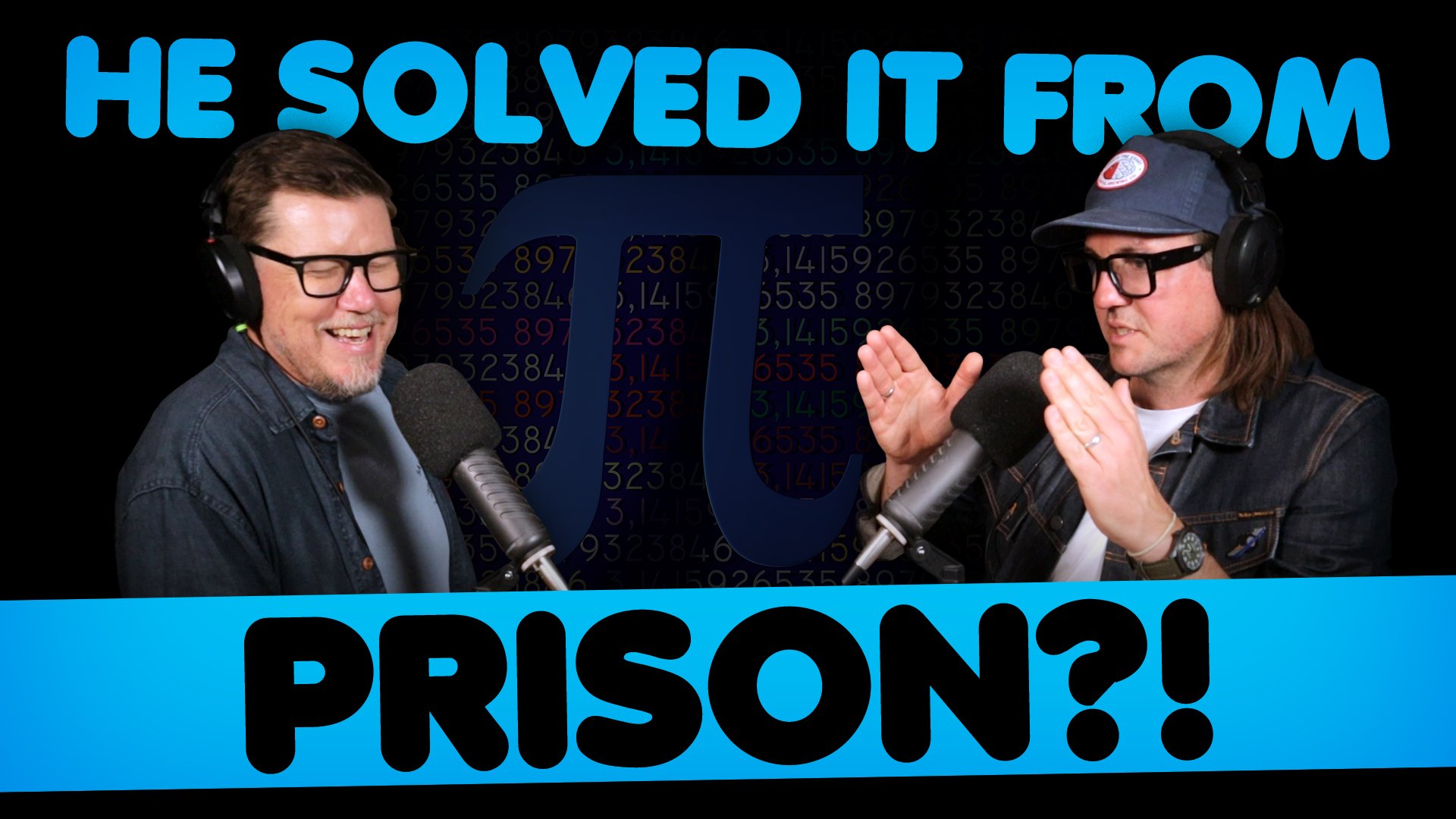
Christopher Havens was a smart kid. While it mightn’t have been the best move for his social status in the fourth grade, he was so keen on maths that he even tutored his classmates. Nerd alert! Maybe that’s why he eventually got caught up in the wrong crowd. He just wanted to fit in and be cool like everyone else.
And of course, being cool meant smoking weed and drinking alcohol, which led to mushrooms and LSD. And then things eventually spiralled into pain pills and crystal meth, which spiralled even more out of control, resulting in him murdering someone. Sigh.
Before going to prison, Haven’s dad gave him some helpful advice to survive incarceration - be the shark, not the clownfish. So, of course, Haven interpreted that advice as beating up another prisoner so he could join a gang. While that act might have confirmed his loyalty to the gang, it also opened the door to his new accommodation in solitary confinement. AKA Hell on earth.
Nothing but blank concrete walls, the smell of your own shit, and a bright fluorescent light to keep you company all day and all night. It was enough to drive a person mad, and by the sounds of the constant kicking and screaming next door, his neighbours were already there. Thankfully Havens was thrown a lifeline…in the form of a maths puzzle.
It all started when a mysterious man (who Havens fondly named Mr G) slid a packet of math worksheets through the slot of his cell door. Craving any form of stimulus, Havens dived in and studied the material at every waking hour. After sleep, he would wake up with the solutions to the problems, his mind completely consumed to the point of no longer noticing the sounds of chaos around him. In the depths of hell, Havens discovered flow state.
Staring down the barrel of a 25 year prison sentence, Havens now saw the concrete walls engulfing him as a blank canvas and decided to rebuild himself completely. He was going to become a mathematician. We’re a little fuzzy on the timeline of when Havens got out of solitary confinement but he quickly churned through Mr G’s entire content. With an insatiable desire for more knowledge, he wrote to his mother to send him textbooks on trigonometry, calculus, hypergeometric summation, and whatever she could get her hands on. You name it, he devoured it.
Having taught himself up until this point (with no library and no internet), Havens sent a lovely handwritten letter to one of the major publishers of serious math journals and textbooks, asking if there was anyone who might help him along his mathematic journey. His letter eventually landed on the desk of Umberto Cerruti, a mathematician in Italy working on number theory.
Cerruti began corresponding with Havens, sending him a complex number problem which Havens solved by hand without any of the computation that would normally be done. This guy was good! So, Cerruti took the tutoring up a notch and sent him a problem that was yet to be solved. A continued fractions problem involving a bunch of irrational numbers with no pattern - some say that’s the reason Pythagoras killed himself.
Normally, to do this kind of maths, you have to test your theory on a computer. But Havens didn’t have a computer. He also didn’t know the problem hadn’t been solved yet. Ignorance is bliss! His cell walls were covered in maths notes, like something out of a B-grade conspiracy horror movie. Hand counting all the way to the end, Havens arrived at a theory that equated for every number. Yep, he solved the bloody thing. When Cerruti saw his handwritten results on a 1.2 meter long piece of paper, it blew him away, knowing that this result would open up new fields of research in number theory.
Haven’s work was published in the ‘Research in Number Theory’ Journal in January 2020 and he has been solving problems ever since. While he continues to serve his sentence and pay his debt to society, for Havens, mathematics not only preserved his sanity and became his passion but is also a way for him to contribute back to society. He started a prison math project, helping other incarcerated people get into maths and a programming system for mathematicians in jail.
It’s an inspiring story and brings to light the issue of recidivism (people going back to jail after they get out of jail). Shockingly, New Zealand holds the highest rate at 61% of people going back to jail within 2 years. The USA and Australia are not far behind at 60% and 53% respectively. And for places like Norway and Iceland where their recidivism rates are more like 20%, what's the key factor? Education.
One study in the UK showed that the recidivism rate dropped from 46% to 5% if prisoners undertook a university degree. For two academics who sometimes (okay, often) complain about the bureaucracy of higher education faculties, we’re happy to admit that education ain’t such a bad thing. In fact, through education and intellectual engagement, it’s fair to say that people can find a path to redemption, contribution to society and perhaps even connection with the cosmos.
SOURCES:
• A conversation with Christopher Havens, Prison Mathematics Project
• A systematic review of criminal recidivism rates worldwide: 3-year update
• An inmate’s love for math leads to new discoveries
• How a maximum security prison offers a pathway to academic excellence and a PhD
• Pioneering Advanced Math from Behind Bars
• Recidivism Rates by Country 2024
• This Inmate Used Solitary Confinement to Learn Math. Now He's Solving the World's Hardest Equations
-
[00:00:00] Will: So I've tried to imagine what solitary confinement in a modern prison must be like.
[00:00:06] Rod: I'm ready. I'm ready. Right. What do you got? Fucking horrifying. Boredom to the point of derangement. Terminal back pain from lying down all the time. On concrete. Shit, you'd sleep a lot. Or at least go into stasis.
[00:00:17] Will: Well, not necessarily. You might not, you might not sleep because usually they might leave the lights on 24 seven.
[00:00:23] Rod: So are you serious? So they go full torture.
[00:00:24] Will: Yeah. You full on lights the whole time.
[00:00:26] Rod: And they play like a 1950s Gene Autry song on mega volume about being happy or something.
[00:00:31] Will: I don't think they do that. I think that would be going too far, but yeah. But as you said, you know, it's a full on concrete box where no, no way to lie down, really. I mean, there might be a concrete slab to lie down on. And the lights on the whole time.
[00:00:43] Rod: I didn't realize. I thought it was just like, all right, look, you've got day and night and stuff, but, and you get one magazine and it's got to be on shoelaces.
[00:00:49] Will: And you've got no one to talk to because you're by yourself in the cell. you know, the guards will walk past and you obviously can't talk to the guards, but then also often your neighbors might be in solitary confinement next door probably going quietly or loudly mad, you know, you're screaming and kicking at the doors and rubbing your shit all over the place.
[00:01:09] Rod: Oh, I've seen before that there's heaps of masturbating. No, I'm sure there is. I bet there's heaps of masturbation. Before you're rubbing shit on yourself, unless that's your version of masturbation, and who am I to judge?
[00:01:20] Will: But probably, I mean, that's the only form of entertainment. But you're right, you know, going slowly mad. I mean, Nelson Mandela when he was in prison they occasionally put him in solitary and he's like, that was the most forbidding aspect of prison life. That was the bit that he dreaded.
[00:01:33] Rod: I went to that prison. I went on a tour of that prison on Robben Island, and the people at the time who would do the tours were former inmates. And we had this very quiet, small, unassuming bloke, and he's walking us around going, Oh, this is where Solitary was, and this is where blah, blah, and I'm just like, Oh, I really don't know how I feel about this. He was lovely and really appreciative and blah, blah, blah, but it was Seeing it was not great. And the lime they were chiseling, that's where they all lost their eyesight because bright glare off. Like it was just, Oh wow. It was fucked up.
[00:02:03] Will: But yeah, but we've also known like that this is horrible for hundreds of years. Charles Dickens. He visited a few prisons and weirdly his dad was in prison and the whole family moved into prison at one point. Charles was old enough that he had a little job on the outside so he'd go there for breakfast and dinner. But anyway,
[00:02:17] Rod: Can I come round to your place? No, they don't really like it.
[00:02:19] Will: No they would have everyone over for breakfast in the prison, I'm not really sure how that works, but anyway, but he wrote the slow and daily tampering with the mysteries of the brain in solitary would be immeasurably worse than any torture on the body. And they knew it like, like 1870, there's records in Danish prisons of people in solitary confinement getting acute signs of mental distress or whatever they would call it in the time anxiety, paranoia, hallucinations.
[00:02:42] But that's where Christopher Havens found himself in November 2012. So, just to give a tiny backstory on Christopher Havens, he'd had a few years running with the wrong crew on the run from the law, losing contact with his kids and his family, and eventually he ended up in Washington State Penitentiary in washington state. So he landed there and his dad gave him some not very helpful advice. I don't know. Maybe it's the advice we all need to go to prison. You know, it's like, do you want to be the clownfish in a sea of sharks? There's a lot of sharks out there. What are you going to do?
[00:03:16] And so Christopher Havens went, Oh, all right. I better be the shark. So he joined a gang and to join the gang, they're like, okay to test your loyalty, you've got to go beat up another prisoner. So he's like, all right, I'll go beat up another. Then he ends up in solitary.
[00:03:30] So he's been in solitary for a couple of months and then suddenly there was a lifeline. A man walked by the door and Christopher noticed him and he was giving out things to the other inmates. And Haven said, what do you got there? Dude didn't say anything. But the next day he came back and he slipped something under Christopher Haven's door. It was a math puzzle.
[00:04:08] Welcome to the wholesome show
[00:04:10] Rod: the podcast in which two academics, he's half on the other half. Take a few beers and dive down the rabbit hole at a rate of knots.
[00:04:18] Will: Quick shout out this this story, Christopher Haven's story is a thank you to a listener thank you Liboy. Liboy, Libwa. I don't know if I'm pronouncing that correct or not correct because that is a username. But anyway sent this to us saying, Hey, I want to hear this story. So thank you very much. If you have a topic listener, chuck it in the comments below or in our email form at cheers@wholesomeshow.Com.
[00:04:41] Rod: So what's your name?
[00:04:43] Will: Will Grant. And yours?
[00:04:44] Rod: Roderick G. Lamberts. The G is for goodness gracious me. My mother was surprised.
[00:04:50] Will: Yeah, fair enough. My mum said the doctor said, I've never seen that before when I came out.
[00:04:55] Rod: A full beard. That's unusual.
[00:04:57] Will: And she was like, what? I mean, I assume that is not the thing any new mother, any new parent wants to hear at the moment of delivery. I've never seen that before. You're like, Oh shit. Here we go.
[00:05:07] Rod: But it's fine.
[00:05:08] Will: Yeah, that's what you gotta lead with. You gotta lead with, we're all fine, but I've never seen that before.
[00:05:12] Rod: That's what I had when I had the this thing go wrong and I had a big weird lump and a kidney explosion and I'm lying in intensive care kind of going, I know what's going on, not under a scanner. And the guy comes in and goes, so you've got this tumor and all I could hear was white noise from that point on.
[00:05:26] And finally he gets to blah, blah, blah, blah, blah, benign, you son of a fucking wank. Lead with benign. Lead with benign. First thing out of your lips before I even know what you're talking about, you idiot. In fact, I've never seen that before. Would have been better.
[00:05:41] Will: Christopher Havens, he was a smart kid growing up. As far as we know, like, he dived into a bunch of things at school, but he dived into math a fair bit. And in fact, you know, by fourth grade his teacher, I don't know how employed or got him to, but he was tutoring the other kids. Yeah. I don't know if, I don't know if he's formally tutoring. What I assume is he's helping the kids next to him
[00:06:00] Rod: in my primary school, if you were tutoring kids in maths in fourth grade, you were definitely the clown fish and not the shark. You gotta come and hang with this guy.
[00:06:07] Will: His dad needed to give the advice. I get it. I get it.
[00:06:10] Rod: Aren't we nine?
[00:06:11] Will: So I don't know, but he was keen on maths and really interested.
[00:06:15] Rod: I got no beef with that. Don't tutor your peers because I think some of them think ill of you.
[00:06:20] Will: But things went a little off the rails. In some stories, this might be because he moved around a fair bit. It's been, Christopher's described himself as saying, I always wanted to fit in and when we move around a fair bit, then I was awkward and fitting in and he ran with the wrong crowd, you know?
[00:06:36] Rod: The easy ones.
[00:06:37] Will: Yeah they're welcoming, maybe.
[00:06:39] Rod: Well you could be a total wankbag and they're like, yeah, cool, so are we. That's easier than actually getting to know people in some more intricate fashion.
[00:06:45] Will: It might be, but anyway there was weed and then alcohol and then mushrooms and LSD. I don't know the time and then pain pills and then meth. I don't have the dates. I don't have the dates. No, I don't know. And I've written and then things spiraled and as he has readily admitted, things did go a little bit out of control.
[00:07:03] Rod: I don't think meth is the kind of thing where you go, I'm feeling really stable, balanced, enjoying my life, have a good set of friends, and I'm interested. I think I'll do a bunch of myth.
[00:07:11] Will: It might be.
[00:07:12] Rod: Not impossible. I think it's less common than other variations.
[00:07:14] Will: You might be fine. You might be fine.
[00:07:16] Rod: I am fine. I am fine. I am fine. I'm fine.
[00:07:20] Will: But yeah he lost his job. He was a cook cooking the graveyard shift. I think the meth made him a little bit paranoid or something like that. He lost his job and as is a common story at the time, well, you know, for many involved, he started dealing and then he got more paranoid and then he and another buddy killed the other dealer that he was working with. Yeah. Not good.
[00:07:41] Rod: That's a big step from I'm doing a bit of dealing. Anyway, I murdered a dude.
[00:07:45] Will: I don't know the full story and that's not the point. All it is to say is, you know, things got bad things got bad. Deed deeds were done and Christopher Havens got his 25 years, which took him to that state penitentiary in Washington state,
[00:07:59] Rod: which is nothing but grunge music so it wasn't all terrible.
[00:08:01] Will: Maybe. All the Seattle sound. Yeah. But jump back to the math puzzle. So here's Christopher Havens when describing that moment, I was in the hole, which is another word for solitary confinement for those of you not in the lingo,
[00:08:15] Rod: Show them your prison tat.
[00:08:17] Will: It's in my hole. I don't think we're allowed to do that. Picture living in a small concrete room where an incredibly bright fluorescent light stays on the entire time. So yeah, he had the full light situation.
[00:08:27] Rod: That's fucking demented. Like, I mean, it's one thing. I can see how people might've thought solitary wasn't active torture.
[00:08:33] Will: Like I can see, yeah, we're not actively pulling a tooth
[00:08:35] Rod: but leaving the light on, giving people no dark time, not good.
[00:08:38] Will: I assume it's also one of those things where, okay, you try it. Like, if you don't think it's torture, demonstrate to me that you would be happy to do this. And I get the whole prison thing is not a thing that we normally demonstrate that you're happy to do
[00:08:49] Rod: This is what I said to the doctor who, while I was still awake, wanted to put a catheter in. And he said, I'm just going to put this in, it's not that bad. And I looked at him and said, have you ever had one? And he said, no. And I said, then don't tell me how it's going to be. It wasn't great.
[00:09:03] Will: Maybe he's got a very wide urethra. So it's probably fine. I don't know what we're looking for in catheter sizing anyway.
[00:09:11] Rod: But yes, if you haven't tried, I agree with you, though, they should try it out. Like spend one day in there with a 24 hour light on
[00:09:16] Will: you know, I would not be happy.
[00:09:18] Rod: You're always happy. You're the happiest guy I know.
[00:09:20] Will: But you know, as a person that likes to see other people and not be trapped in a windowless box
[00:09:25] Rod: That's all right, man. That's not your fault. You're a sociable guy.
[00:09:27] Will: Well, here we go. He says 24 is not the problem cause time has no meaning with no windows to the outside and no remarkable features to mark the passage of time. In fact, there's no remarkable features anywhere. Even the bed is made from the simple concrete slab. And then he's he did have the screams of the prisoners next door who were less healthy.
[00:09:43] Rod: Yeah. Some human contact
[00:09:46] Will: well, yeah, sure, sure. No human being is visible from inside the cells in the hull, save for the silhouette of a face on the other side of a narrow window. And so, men are kicking the wall, sometimes for several hours at a time.
[00:09:58] Rod: Fuck.
[00:09:59] Will: Now, just to jump ahead in Christopher's story He becomes a bit of a mathematician, but I liked his next sentence.
[00:10:05] Rod: It's the next obvious thing.
[00:10:06] Will: I like to define hell as being the Nth layer of rock bottom as N increases without bounds. And he was saying that this is where he found himself in the Nth layer of hell where it just gets worse and worse. Sometimes it felt like on the other side of the concrete wall, I would reach that infinite limit. My way of passing the days was to play Sudoku and exercise. And when noises from the outside doors could be heard, I'd walk over and look. They let him have a Sudoku. I think one to do it over and over again.
[00:10:31] Rod: And no rubber. Sorry for our american listeners I mean, eraser.
[00:10:35] Will: Yeah. Almost always the people walking past is the guard or a nurse, but on occasions, there was a gentleman who would walk past with a manila envelope and passing things under the doors of a couple of other prisons. Now I love patterns. Even then I try and track the patterns of what's going on.
[00:10:49] The older gentleman was such a pattern. He'd come on certain days, twice a week. I don't want to get too caught up, but my curiosity was piqued and it led me to asking me exactly what was in those envelopes. Mr. G, as he called him later, didn't reply. But the next day, a packet of math worksheets slid through the slot of his cell door.
[00:11:06] And it was algebra, whole bunch of math puzzles that you know, the, they were passing out and Christopher just dived into it. As you can imagine, your brain is looking for any stimulus and it's just like, oh, okay.
[00:11:18] Rod: Did they give him a pencil as well, or he just had to do it in his head?
[00:11:21] Will: I don't know. Nothing remarkable, but it was all new to me. I studied this material for every hour that I was awake. When I slept, I would wake up with the solutions to the problems I could previously solve. So as soon as he's got it, he's just got, this is filling all of my time when I sleep, I wake up and I'm doing more maths.
[00:11:36] If I sat with each of the problem of Mr. G's sheets for long enough, I could always come up with a solution. So I'd stay up all night, but I'd find a solution to these problems. And he thought, Oh, okay.
[00:11:46] Rod: He doesn't know if he's staying up all night, but I'll take his point.
[00:11:48] Will: Fair enough. No, he doesn't. No, he doesn't. I spent weeks in this pattern and to speak truly, I can't remember a single voice screaming, no sounds of chaos. So suddenly In this, in solitary confinement where it's been screaming and banging and just being alone. He's just gone, Oh I don't hear anything. I've achieved flow state in the midst of hell. Like suddenly flow state has been given to him by these math problems.
[00:12:10] Rod: Do you reckon maths would do that for you?
[00:12:11] Will: Look, I actually, I like maths. I'm okay. But I've, you know, as many people, I've forgotten everything I ever knew. But I could imagine being there and you're given a puzzle. You're like, well, what else am I going to think about? What else am I going to do?
[00:12:24] Rod: Rubbing poo on yourself.
[00:12:25] Will: Yeah. And, but you can only do that for so much.
[00:12:28] Rod: It's true. They don't feed you a lot, I'm guessing.
[00:12:29] Will: And then you think, well, whatever, maybe I'll do a math puzzle. Yeah. It was funny. I stood there and I looked at that plain concrete wall. It was meant to security against me, but I saw it as a blank slate. I decided right there that with 25 years in jail, I could choose to embrace mathematics and completely rebuild myself. I remember thinking with 25 years, I could become a mathematician.
[00:12:48] Rod: You know what? I reckon he could.
[00:12:52] Will: Yeah. So it was an algebra course that Mr. G was giving out. And every time he'd come past he'd take the other ones and he'd correct them and give back the old ones to say, okay, you got this, right? You got this wrong. Blah, blah, blah. But soon he was saying to Mr. G, do you have anything more like, what do you got? Dial me up.
[00:13:09] Do you have some harder packets? And Mr. G was passionate about maths but at some point, like, he was like, that's it. So he passed a little note and said, Mr. Havens, I wish you luck on your journey, because he had maxed out everything that Mr. G could do, could give him. And Christopher Havens was like, well, I don't want that to be the end of my journey.
[00:13:28] Rod: Didn't Mr. G have access to a photocopier or a library? Or did he correct his work?
[00:13:31] Will: No, but Christopher Havens went, well, I can do this myself.
[00:13:35] Rod: And he wasn't in solitary this whole time, right? How long was he in there? Are you going to tell me that later?
[00:13:38] Will: No, he's still in jail.
[00:13:39] Rod: In jail, but not solitary the whole time.
[00:13:41] Will: I don't know when he came out of solitary. So he was a few, like, he was definitely for a period of, in, in solitary.
[00:13:47] Rod: And that's where this kicked off.
[00:13:48] Will: Yeah. Yeah. And I think he's still in solitary at this point. I think still in solitary, but I don't have the timeline of when he got out of solitary.
[00:13:54] So Havens starts asking around, he writes letters to his mom, to other people to get any math textbooks or anything, examples that he can get. He teaches himself trigonometry, calculus, hyper geometric summation and soon like he would write to his mom and say, can I get this textbook? And she's like, I don't understand any of those words, but I'll do my best.
[00:14:14] Rod: Mom, you don't need to, we've been through this. You don't need to know what they mean. You just need to be able to show them to a book person.
[00:14:20] Will: So, in January 2013, and remember, he'd been in Solitary November 2012, so he's been in there for three months
[00:14:28] Rod: Three months?! What the fuck did he do? I mean, seriously.
[00:14:31] Will: But, by this point, but here's the thing by three months later, he's written to one of the publishers of a whole bunch of serious math journals and textbooks. So it was mathematical science publishers, classic name there. And said, he said he was an inmate trying to learn advanced maths. I love that. There's a copy of his letter to them.
[00:14:49] Rod: If we had a dollar for everyone who said,
[00:14:50] Will: I know, well, you'd be surprised. And it's a nice handwritten letter here to whom it may concern. I'm interested in finding more information on a subscription to analysis of mathematics for personal use.
[00:15:02] I'm currently serving 25 years in the Washington Department of Correction and I've decided to use this
[00:15:06] Rod: For a little bit of murder. I hope you don't mind.
[00:15:08] Will: I don't think he said that, but that's all right. Use this time for self betterment. I'm studying calculus and number theory as numbers have become my mission. Can you send me any information on your mathematical journal? Christopher Havens, and then he's put his prison number there. P. S. I'm self teaching myself and often get hung on problems for long periods of time. Is there anyone who I could correspond with? Provided I send self addressed stamped envelopes.
[00:15:28] There are no teachers here who can help me. So I often spend hundreds on books that may or may not contain the help I need. Which, fuck, that'd be frustrating. Thank you. And so he's sort of clutching the, cause he can't do internet searches. He can't do library. So he can get things sent to him. So like a textbook or something like that, and he can write to get, but he has no knowledge of what is actually out there other than what has been in the book that he's just got.
[00:15:50] Rod: I feel like in some ways that could be better because I mean, just frivolously or skipping across a bunch of internet searches doesn't require you to dive deep and think hard.
[00:15:59] Will: There's at least two ways where it clearly did help him. Absolutely. No, absolutely. And I think it's an interesting thing. The editors said, all right, we'll pass this around. They passed it to, and eventually it landed up with Umberto Cerruti, who's a mathematician from Italy.
[00:16:14] Rod: You have to be, with a name like, as soon as you're Umberto, you must be intellectual. Because that's the second Umberto I've heard of, and the other one is Umberto Eco, and he's intellectual. Therefore they all are.
[00:16:24] Will: Sorry for street fighting Umberto's out there.
[00:16:26] Rod: They can be smart too. God, you're so, so racist.
[00:16:29] Will: He's a mathematician in Italy working on number theory. Cerruti said, all right, well, here's a problem for you to solve. And it was, I think it was a number of number theory problem. But Cerruti knew the solution to it. So, he writes over Havens does the solution.
[00:16:43] And remember he, he can't use computer here. He's working it all out by hand and a lot of number theory stuff, you actually need to do a whole bunch of computation. He writes it back and Cerruti is like, Oh damn, you got that. That's pretty good. Okay. So Cerruti then is like, well, I'm working on this problem and he didn't tell Havens this, but he said he sent him a problem that currently didn't have a solution.
[00:17:02] Rod: No. No
[00:17:03] Will: totally. No he was like, okay, this is the, this is a problem. Can you work on this? And now here's the first thing. A lot of people have said that a lot of people might Google this if you are outside of the prison and go, Oh, there's no solution.
[00:17:17] And then instantly go, well, then it's not solvable or you have to be, you have to be a professor of mathematics from wherever to be able to solve it.
[00:17:25] Rod: You have to be four Einsteins plus.
[00:17:27] Will: Havens couldn't know that. So he dived in.
[00:17:29] Rod: Ah, the bliss and beauty of ignorance.
[00:17:31] Will: Now, I'll just give a brief idea of the problem. I'm not going to cover it deeply because
[00:17:36] Rod: For my sake. I mean, I know you understand it, but it wouldn't be fair to me and I appreciate that.
[00:17:40] Will: Yeah, it's one of the two. It's one of the two. It's in number theory. But there's a thing called continued fractions. So a rational number, you can divide it fairly neatly. So integers, two, three, four, five, they're all rational. Then short fractions, so a quarter, clean boundaries, even if they recur like a third. But that's simple. You can see the pattern. So one point, you know, 3. 333. Yeah, it keeps going. Irrational numbers. You know, they, the numbers keep going, they keep going and there's no pattern. You can't detect anything going on. So pie, for example, 3. 14 and so on.
[00:18:13] Rod: We don't know if it repeats.
[00:18:15] Will: We, we assume it doesn't, but there hasn't been a pattern found in it. But the point being, you know, an irrational number doesn't have a pattern. And that's apparently why Pythagoras killed himself.
[00:18:25] Rod: I thought it was because his girlfriend didn't like him anymore. No, it's not because of the lady, it's because the irrational numbers make no sense.
[00:18:33] Will: I could get anyone, but it's irrational.
[00:18:35] Rod: Do I get a light? I get a light all the time. I know he's Greek, but hey, Italian will do. As if I do it over a girl.
[00:18:41] Will: But you can represent these numbers using fractions. So, so for example, pi can be represented as three plus a seventh plus a 15th plus something like that. And then you can nest all of these fractions. Yeah, I know. I know it's okay. It's okay. You don't need to know this.
[00:18:58] You don't need to know, but you can nest these fractions and keep them going down. The problem is. To do this maths normally, you can come up with a theory, but you got to test it on like a computer. You got to run it through the machine to be able to see what's actually going on. And the thing is, Havens didn't have a computer, so.
[00:19:15] Rod: Should have thought of that before we murdered someone.
[00:19:17] Will: A couple of years later. He has covered his cell wall. Now, I don't know if he's in solitary or not at this point. You know, you know, I haven't seen a picture of this, but I've got the images of, you know, the people that cover their walls in like Bible pages or something like that.
[00:19:28] Rod: Every wacky conspiracy, usually Judeo Christian based horror movie has got that.
[00:19:33] Will: He's got his cell walls covered in math notes where he's working out all of these these number theory continued fractions problems all the way down. And he's hand counting all the way to the end and eventually, he comes out with a theory that equates for them all. And he writes it out on like this one long piece of paper. It's like 1. 2 meters of paper. He sends it off to Umberto Chiruti
[00:19:54] Rod: who chokes on his limoncello.
[00:19:56] Will: Yeah, he did. He did. I assume so let's assume that's what he did, but he, my God, he put it through the computer and he's like, Oh my God you have solved this thing that no one has ever done. And as you can imagine, you know, now he didn't provide a universal solution, but it was transformative and no one had done it before. This result can open up new fields of research in number theory. This is the thing that there were people, you know, you know, the story of murderer in jail, solve math problem, like, like legit math problem.
[00:20:25] Rod: The right wingers is like, so he killed a guy and he knows one plus one equals two. I don't give a shit. Look, it's not a math problem, dude.
[00:20:33] Will: So he published this in the journal research in number theory in January, 2020, as you can imagine newspapers were loving this story.
[00:20:40] Rod: Corresponding address. Can we have your email? No.
[00:20:42] Will: Like the idea of murder solves unsolvable problems.
[00:20:46] Rod: Does it have to be in the author bio?
[00:20:47] Will: I'll come back to that later, actually, because that's an interesting point. I mean, correspondence is a challenge and has always been a challenge for him.
[00:20:54] Since that point so Haven's published his first paper in 2020. This was this groundbreaking work in number theory.
[00:21:00] Rod: It's wild. It's just wild.
[00:21:01] Will: He's published a few other things in maths as well. Since then he's working with people on other sorts of problems.
[00:21:07] Rod: And he's still in jail. Are you going to get to that?
[00:21:08] Will: Still in jail.
[00:21:09] Rod: They won't let him out for services to maths?
[00:21:10] Will: Well, this is the thing. He's starting to think about what he's done. He's said many times, I was reading interviews with him where he's like, I do want to pay my debt to society and the way that I want to pay it
[00:21:22] Rod: is mathematically.
[00:21:23] Will: Absolutely. No, there's multiple things, but he does believe that part of them is by contributing to maths, he is also contributing to society by opening up new discoveries.
[00:21:34] Rod: I agree. And it's just beautiful.
[00:21:36] Will: But I mean, he said a few other things as well. Since that time, he's continuing to work on mathematics projects like maths, but he's doing a bunch of projects around maths as well. First he's building this prison math project where helping other incarcerated people to get into maths.
[00:21:50] Rod: Always tutoring the year fours.
[00:21:51] Will: Yeah, exactly. Exactly.
[00:21:53] Rod: Does that make him a shark or a clownfish in this context?
[00:21:55] Will: I don't know. So I think it's a new form. It's not clownfish or shark. It's like, you know, you can transcend by being different.
[00:22:02] Rod: Octopus. Because no one knows what's going on there.
[00:22:04] Will: And no one fights an octopus. But yeah, so spreading this around prisons around the US they do things like obviously tutoring different people in jail. They bring in outside mentors from university math departments and things like that. They celebrate pi day, which it's a nice thing to do.
[00:22:19] Rod: Do they actually get special food for that?
[00:22:21] Will: Probably not. I don't know.
[00:22:22] Rod: Happy Pi Day. What does that mean? Yay for 3. 14.
[00:22:24] Will: Let's say it depends on the prison. But when mathematicians, they bring in mathematicians for visits to prisons. And in these events, mathematicians become rock stars in the eyes of the prison population.
[00:22:33] Rod: Just imagine a dude getting wheeled out. You got a visitor, it's a special visitor. He's like, I'm going to go to, I'm going to go to the special caravan. I'm going to go to the special caravan. I'm going to go, I'm going to go. It's a mathematician.
[00:22:42] Will: And, I'm going to go to the special caravan and it's going to be a mathematician.
[00:22:45] Rod: Now, what do they call it? Conjugal visit.
[00:22:47] Will: Yeah. You can have a conjugal and calculate.
[00:22:49] Rod: I'm going to scream numbers while you blow me. Carry on.
[00:22:53] Will: But yeah people like the mathematicians become rock stars at these visits. It was magical. They're all getting autographs and stuff. He's also built a programming system and I'm not sure how this works, cause they're not really allowed computers very much, but a programming system so that mathematicians in jail can use this programming system. But the thing he's also looking at is, you know, this pathway and he's published on this in the journal of prisoners on prisons, so it's a prisoner written journal.
[00:23:17] Rod: Journal of prisoners on prison.
[00:23:19] Will: Yeah. Just talking about prison conditions and things like that.
[00:23:22] Rod: Who publishes it?
[00:23:23] Will: Canada, the University of Ottawa Press.
[00:23:25] Rod: Prisoners on prisoners.
[00:23:26] Will: Yeah, no, it's it's been going for 30 years and
[00:23:29] Rod: there's an episode right there. Like that's fascinating.
[00:23:31] Will: Prisoner written, academically oriented and peer reviewed non profit journal based on the tradition of the penal press. So I think the penal press is an older school version.
[00:23:38] Rod: It's going to be funny every time you say it.
[00:23:39] Will: The penal press. Brings the knowledge produced by prison writers together with academic arguments to enlighten public discourse about the current state of prisons.
[00:23:46] Rod: Huh, like little prisoner on prisoner action, that's wild.
[00:23:49] Will: In an age where crime has become lucrative and exploitable
[00:23:52] Rod: like Prisons for profit?
[00:23:53] Will: Yeah it's for profit prisons. And you could imagine the writers in the Journal of Prisoners, like, they would be furiously angry at for profit prisons.
[00:24:01] Rod: There are a few things. I mean, I'm probably easily disgusted by many social, you know, just dysfunctions, but that there's another episode right there, like for profit prisons.
[00:24:10] Will: Oh, Jesus Christ.
[00:24:12] Rod: The mere idea. Imagine getting there and going, I've got an idea. I've got an idea.
[00:24:16] Will: One of those things, I think there's a few things, but only governments should pay for it.
[00:24:20] Rod: No. I want to incarcerate people for money. What do you reckon?
[00:24:22] Will: If you believe you have the right to lock up other people, then it's gotta be government.
[00:24:26] Rod: Profit. Anyway, sorry, but that that just really drives me crazy.
[00:24:30] Will: There's this nice quote, I research in number theory in my free time and recently had my second paper accepted for publication at a professional journal.
[00:24:37] Another was recently submitted and more on the way. However, my contributions to math, nothing special. What I mean is that my work in number theory is no different than the work of any other math mathematician in their own field. I've never make any groundbreaking discoveries. And he was really angry at people calling him the new Euler or something like that. He's doing good stuff.
[00:24:53] Rod: I'm just a dude doing maths.
[00:24:54] Will: And I'm not trying to be the best. Indeed, I do maths because it's in my heart and an endeavor of beauty. My real work lies in a huge effort to understand the role of maths in self identity and desistance from crime. You know, you talked about Erdős a while ago. Paul Erdős, like greatest mathematician in the 20th century.
[00:25:09] Rod: Which we mistakenly said Erdős the whole time. For those of you who don't know what Erdős is spelt like, it's spelt Erdős with some thing else.
[00:25:15] Will: But he's like one of the most productive mathematicians ever. A lot of mathematicians look up to him. And I think, you know, we talked about this. It's not like he wanted to maximize his H index or something like that. He was doing it because he wanted the connection with other people and doing it because he wanted the connection with other people.
[00:25:32] And I think there's something really interesting in Havens. He found in the cell there that there's a moment where maths can be Not only a way to escape the cell, like, like literally his mind is going somewhere else. He's not hearing the noises. He's not trapped in solitary confinement that way. He's communing with the cosmos.
[00:25:51] Rod: But it's not something you hear every day. Like, you know, we offer advice to undergrad students coming through or getting into uni stuff and you don't often hear, I want to connect with other people. I think I'll do a maths degree. It's not the first thing that probably tends to come up.
[00:26:04] Will: Probably not. But I think there is something really nice that it was a moment where his brain, he was kept in a quiet place where he could spend time.
[00:26:11] Rod: Yeah. And look, no, no diss on that. It's just. It's not the first thing that comes to mind.
[00:26:15] Will: No. But as a redemption story, as someone going, actually, what I've found here is a way for me to contribute to knowledge, but also find something that I am passionate about in the day to day
[00:26:27] Rod: and it's creative too, like he's building.
[00:26:31] Will: So I just wanted to touch a little bit on, on the idea of recidivism and what education can do, because you know, recidivism is people going back to jail after they have been to jail.
[00:26:43] Rod: Let's just call it a sequel.
[00:26:44] Will: Yeah, it is the sequel, but you know, if we're sending someone to jail, well, hopefully the point is to rehabilitate.
[00:26:49] Rod: It's not punishment, it's rehabilitation.
[00:26:51] Will: That that they come out of the jail, they're a better person, they're not going to do the crime again. But recidivism rates around the world, they're pretty high.
[00:26:57] Rod: I can't imagine why.
[00:27:00] Will: Look, it can be that there are, that maybe it is the person themselves.
[00:27:03] Rod: No. Everything else?
[00:27:05] Will: Everything else. Okay.
[00:27:07] Rod: The entire system is set up around someone who says, Oh, you've been in jail. I want to get a job. Oh, but you've been in jail. So you can't have a job. Don't turn to crime. All right, I won't. Can I have a job? No, you've been in jail. But I'm rehabilitated.
[00:27:19] Will: Well, I just want to touch on something on that. We can define recidivism in a bunch of different ways. Like, like if it's re arrest or if it's reconviction or going back to jail and at what time period, like one year, two years, five years. But anyway, if you look at two year reconviction rates, which country do you reckon is the worst? Now this is why I only have a small number of stats of countries here mostly OECD. Okay. But you want to guess which is the
[00:27:42] Rod: Venezuela?
[00:27:43] Will: No, it didn't make the list. I don't have that in the list.
[00:27:46] Rod: Okay. I'm going to say the channel islands.
[00:27:50] Will: You're not guessing real country. They're not a real country.
[00:27:52] Rod: Kuwait.
[00:27:53] Will: No, New Zealand came out at 61 percent as the highest recidivist rate.
[00:27:56] Rod: That's because their jails are tops bro.
[00:27:58] Will: Well, maybe everyone wants to go back. I don't know. But the U S 60%, Australia, 53%. We're not doing super well.
[00:28:04] Rod: Over half.
[00:28:05] Will: Yes. Over half. Over half at two years back in jail.
[00:28:10] Rod: Really? Really? Yeah. Now.
[00:28:12] Will: Or reconvicted. So, yes.
[00:28:15] Rod: Within two years, more than half. Holy shit. I know I'm really, anyone who's listening to this in jail or has been in jail is going, you're ignorant, like privileged fuck, but I would, if you'd said 25 to 30%, I'm going all right.
[00:28:28] Will: Well, only your advanced Norway and Iceland and Austria
[00:28:33] Rod: because no one can tell the difference between in jail and out of jail, except when you have to go to bed as a grown up a bit earlier than you might expect.
[00:28:40] Will: Norway does make 20% Iceland, 26%. It's almost like, so, so I had to look, you know, what is the, there's a lot of things that will minimize recidivism rates. You know, your structures on the outside, how you might help people to get jobs, help people to get lives, all of those kinds of things. One of the biggest things you can do in jail. This is the in jail thing. It's freaking education. It is education.
[00:29:01] Rod: Look. What do you know?
[00:29:02] Will: Square the circle. So, it lowers the rates of recidivism enormously. Some found like 29%, some found like 46%. There's one study in the UK. 46 percent of all prisoners will re offend within a year of release. So that's slightly different from the stats we had before, but this is in the one year.
[00:29:18] So 46 percent will re offend, but less than 5 percent of the people that do a university degree in jail re re offend. So it drops from 46 to 5 percent if you do a university degree.
[00:29:30] Rod: So that's no big deal.
[00:29:33] Will: Look, it's not necessarily easy to do, but all it's saying is you give people education and suddenly jail is a different prospect.
[00:29:42] Rod: So we should make it more expensive.
[00:29:44] Will: So I think the thing here, you know, Christopher Havens he has math projects that he's working on, but he amongst others is opening the door to say, hang on, maybe prisons are necessary. I don't know. I don't know. There probably is a bit where keeping society safe and all of those, that's probably necessary.
[00:29:59] Rod: This is a good thing to talk about though. I mean, I know we're a bunch of left leaning hippies, blah, blah, blah. What?! But someone, like, stabs my friend or loved one, I want them fucked up.
[00:30:10] Will: But also, fucking them up doesn't bring them back.
[00:30:12] Rod: But if someone hurts something I care about, then You know, my blind rage turns. More broadly, yes. I think the idea of it, I understand that the call for revenge for punishment, et cetera. I get it. And in some cases there are people who should not be circulating freely because they don't know how to do it without hurting people in however way, however ways they hurt them. That doesn't mean we just go insane. And I mean, again, I'll just, I won't keep going, but private prisons, that's going insane.
[00:30:34] Will: But also, I mean, I think it's, you know, you can think of what is the prison and prison as keeping the rest of society safe. That's one, but prisons for punishment. Prisons for profit. You know, prisons as a part, a necessary evil in which we might rehabilitate people for a better life.
[00:30:50] Rod: Well, I think that there's at least two strands. One is if you really clear that these people are irredeemable, how you decide that of course is open to contestation, but fully irredeemable people for whatever reasons it may be is one thing. People who have just fucked up. And often it's because they've had, you know, situations, that I agree with rehabilitate, retrain, et cetera. So I think there's kind of at least two kinds of prison. One is look, we don't know what to do with you. We really don't. And the other is everyone else.
[00:31:18] Will: There's a bunch of ways you can support Christopher Haven's project and others that are bringing maths and other forms of education to incarcerated people.
[00:31:25] Rod: Are you about to ask me for money?
[00:31:27] Will: I'm not. You can find them out there on the web cause I couldn't write the links down. But I think this is one of those things where if we actually want prisons to do the right thing, then if we can providing education, you know,
[00:31:38] Rod: a hundred percent thought we should be doing
[00:31:40] Will: another thing that we can think about, there's a movement called ban the box.
[00:31:43] Rod: Wait, what? Not television.
[00:31:45] Will: No, it's not. No, this is criminal history check on things that aren't necessary. Now I get, there are certain places where absolutely, you know, you're working for a bank or something like that.
[00:31:54] Rod: Have you been a robber?
[00:31:55] Will: Yeah. Did you rob banks in the past? I think allowing that box is fine, but removing it from places like university admissions in innocuous programs
[00:32:04] Rod: it's in there. Do we ask that?
[00:32:06] Will: I don't know if we do.
[00:32:07] Rod: I've never seen a form on our university, but I haven't looked at forms for a while. You want to flip burgers. Like, have you ever had a bad car accident that you were drunk for?
[00:32:14] Will: Not relevant. But recently the UK had a box on there. You know, have you been incarcerated in their university admissions and they have removed it. And so there are efforts by a lot of formerly incarcerated people and currently incarcerated people say, get rid of the box. if it's relevant, I get it. I get it. But can we just stop
[00:32:30] Rod: If you've been naughty and you want to work in a, you know, Kindergarten. No.
[00:32:32] Will: Just, this whole making it harder for people is what we want to do. Like, come on.
[00:32:37] Rod: Or stop calling it rehabilitation.
[00:32:40] Will: Hey, just a final little point that I found, solitary confinement doesn't work.
[00:32:44] Rod: What? So it's not as useful as torture.
[00:32:46] Will: Well, okay. It does the same things but we can say solitary confinement, one, either it's a punishment, but again, that's not rehabilitating people. Or it's keeping the prison lower in violence. So if you're violent and other prisoners then you're gonna be put in your solitary
[00:33:02] Rod: until you get out.
[00:33:03] Will: Yeah. That's the thing. Research on this has found that actually it increases antisocial tendencies.
[00:33:11] Rod: So cutting people off from society makes them more antisocial. Isn't that in the journal of prisoners for prisoners? We just realized when we locked this guy up, like nine days out of 10 over the 40 years he's been here, he's been alone. When we put him back in the general population, he's a bit messed up. Fucking assholes.
[00:33:29] Will: You might be horrified to know how many prisoners. Like in the US there are a lot of prisoners. I don't have the total number here. But throughout Covid they threw hundreds of thousands of people into permanent solitary confinement. So that no one gets the covid.
[00:33:41] Rod: For their own good. Sorry.
[00:33:42] Will: Yeah. Just another, you know. We will be reassessing COVID for quite some time. But this idea of suddenly just going, Oh, let's en masse, just throw prisoners into solitary confinement. That will solve the problem.
[00:33:54] Rod: Well, if the problem is you can't transmit disease through concrete walls, then yes. Is that the problem?
[00:34:04] Will: What have you been thinking about?
[00:34:05] Rod: I'm still thinking about that, to be honest, like that. Actually, this is not unrelated. I was thinking about, can you plead insanity in Australia and what does that look like? We were told in psych classes, insanity is only a legal thing and nothing else. And I thought, okay, that's quite interesting. But the whole idea of pleading insanity or some equivalent, I'm just curious about the nuances.
[00:34:25] Will: I feel like it's a catch 22. Cause if you're cognizant enough to be able to plead insanity, then yeah, surely.
[00:34:31] Rod: You don't have to plead it yourself. You have a proxy. They call them lawsters.
[00:34:35] Will: Are you looking for an insanity defense?
[00:34:38] Rod: That's good to have one in the back pocket don't you think? You never know
[00:34:40] Will: maybe at any moment, take a shroom.
[00:34:42] Rod: Social mores change, you know, the drop of a hat and I could accidentally transgress or could I, cause I'm insane?
[00:34:49] Will: I watched a TV show a little while ago, but it had a laugh track. I'm like, Whoa. Whoa. So weird.
[00:34:55] Rod: It's horrible.
[00:34:55] Will: So weird. Why did we decide a laugh track is a good thing?
[00:34:59] Rod: But you know, some of the modern ones have them and the modern really shit sitcoms, usually American, but not always that by modern, I mean this century, at least when they have a laugh track, it just makes me already angry than the shit jokes that they already have.
[00:35:13] Will: It's cringe. It's cringe, but it's also why did we need to be told when to laugh?
[00:35:18] Rod: Because some of them just aren't funny.
[00:35:20] Will: Are there shows that still have laugh tracks? Where are they more common? Who is doing this?
[00:35:23] Rod: Are you ready for my racial biases? America. That's it. That's my whole answer.
[00:35:28] Will: Maybe, maybe that's because they produce most of the TV. They produce all the TV that's worth watching anyway.
[00:35:33] Rod: I want to fight with you, but it's hard. Oh, the poms do some stuff.
[00:35:36] Will: I am interested in laugh tracks. What else have you been interested in?
[00:35:40] Rod: I was kind of musing on the idea of confirmation bias and is there anything good about it? What are the good bits of confirmation bias where you are fueling your own beliefs and preferences, et cetera. Whether you mean to or not, there's got to be some good stuff about it. I don't know what it is yet
[00:35:53] Will: like good confirmation bias.
[00:35:54] Rod: Yeah. I want good confirmation bias. What's the good stuff about confirmation bias other than the entire way I move through my own world?
[00:36:02] Will: Yeah. So I'm confirmed in myself. Maybe you're happier. Like if you dial up the confirmation button, people are happier.
[00:36:08] Rod: I am. Like, that shat me. And then I saw an example that I choose to think is representative of that thing that shat me. I am right to be shat.
[00:36:17] Will: I've been watching a bit of the Trump courtroom dramas and I've just, you know, it's rare these days that it's the only place where sketches are, you know, a legitimate job. And I just want to know the history of courtroom sketches and what's good, what's bad. What are you trying to capture?
[00:36:33] Rod: Fuck, it's clever, isn't it? Oh, we don't have the cameras in here, but can a dude come in and use crayons? Yes.
[00:36:39] Will: Like it's kind of nice though. Like it's a nice preservation. I feel like they should get, you know, you know, we go to the markets and they're like, I'll draw your caricature. I want to see that.
[00:36:47] Rod: Look at the size of your chin. It's true though. No, it's hipster. It's hipster.
[00:36:51] Will: It's so weird that the court, I mean, the courts are very hipster. I mean, look, they wear wigs and they love the old school, but there's a bit of me that thinks about courtroom sketches.
[00:36:59] Rod: Is that, was that maybe inspired by Jon Stewart?
[00:37:02] Will: Oh, no. I mean, many people did a bit, I mean, this is getting old for you now and the future listener. But many people have talked about courtroom sketches around Trump. I mean, I'm just interested really, like, like, what are we trying to achieve here? Where did that come from? Why do we preserve this? What's going on?
[00:37:15] Rod: Just take a photo. Yeah, I agree. I like that one. I like that.
[00:37:19] Will: You got any more?
[00:37:20] Rod: Well, this one, there's no way in hell I could cover it because it's far too clever and confusing and it's worse than the maths one, but the notion of randomness and does true randomness actually exist?
[00:37:28] Will: It's the edge of the universe. You escape through randomness. You told me that before. You said this is how you escape the universe is by finding a random number. And then you can, like, I'm sure Christopher Havens, if he found a random number, a purely random you know, that's what, that's why Pythagoras killed himself. He was escaping the universe because he found an irrational number.
[00:37:45] Rod: Not irrational, random. I mean, the only, look, the reason I think about this is because, you know, as we both do when students come to you and go, okay, so we randomly selected some people.
[00:37:53] It's like, look, to say the word random. No, we just got to be clear what you mean? What you mean is you'd never been like actual random. And then I remember years ago talking to someone like a physicist going, okay, we're trying to generate a truly random number. So we've got this cloud of cesium atoms at just above absolute zero and we fired a laser where we don't know which prong it's going to come out of. And we've done that by rolling a dice and then spinning a turtle on its back. And then boom, it hits one of the atoms and that's the number that relates to the number in ways I can't understand, random number.
[00:38:23] Will: A, that there would be a desire for this level of random, and B, that there is some cool physics to achieve it. That's so cool.
[00:38:30] Rod: It's kind of the reverse of confirmation bias. It's like the most Hardcore way you can say, there is no way in shit we've influenced what we've looked at because we've generated it from a truly random number.
[00:38:39] Will: But, but from a very different perspective, there are some people out there that are like, no, we are, and this is one of the topics that I'm interested in we are fated. Like, like the universe will roll out as it will, we have no not intended. No, not even intended. We have no free will and all we are and every single atom in the universe is not written by a God, but it will happen in this way because this is the way it will happen.
[00:39:05] Rod: Because if X hits that, then that hits that.
[00:39:07] Will: Yep yep. And they're like no. You don't get it. All the way down to the bottom. This has all like, you could run the universe back and forth on the same tape and it would happen the same every way.
[00:39:16] Rod: How do you not like foundation then? The Apple series, because that's psycho history. Terrible name, but you know, the point of it is basically it's all ultimately Predictable.
[00:39:27] Will: But you know, you know, you know, this is I'm going to cheat cause there's two topics I want to talk about but there is, I kind of feel like, are we becoming, are we becoming more fatalist right now where we look at the trajectory of the world over the next few years and we go, Ah, well, non zero chance, World War III is coming, you know, and we just go, ah, oh, well, I wish we could do something about it, but no, we can't because we're fated. We're fated. And I'm like, God damn it. Maybe we are.
[00:39:55] Rod: Well, then you've got to, you've got to look back in time and go, how many times has that already happened? Like. Heaps.
[00:40:00] Will: Yeah, sure. I just wanted to flag one last topic. So a buddy of mine sent a paper and this just tickles me. Up in Queensland there's a bit, there's, this is a Australian state, got a lovely coral reef out the front. Well, bits of it. So on the front lawn, we've got a nice coral reef.
[00:40:14] It's pretty. Well, not as pretty as it was. And one of the problems is there's, oh, dastardly starfish, the crown of thorn starfish being out eating the coral. So the Queensland government has been killing the starfish and deep down, the weird thing for me is. It's a native species and we're like but we want the other native species, not this native species.
[00:40:35] And they're like, literally they're sending scuba divers down with little syringes to inject these things. And I'm like, what are we doing here? It's humane. And some researchers just come out from a buddy of mine that says, you know, you know, maybe it's not motivated by the science. It's motivated by other things.
[00:40:51] Rod: What? When has that ever happened? You're freaking me out, man.
[00:40:56] Will: I just want a quick one from the mailbag. I was informed by my mother after listening to your discourse on redheads. She describes it as, My great granny was a full on redhead. She says full on redhead.
[00:41:09] Rod: As in hers or yours? Her grandmother was a full on redhead? Does she know? Like, did the collars match the cuffs?
[00:41:16] Will: Jeeze Louise! She's in the olden days aren't allowed to ask questions like that.
[00:41:21] Rod: That's all they asked.
[00:41:22] Will: That's how they asked her. That's all they asked. Ah, we'll be back in the future, listener.
[00:41:36] Rod: It's pretty metal. It's pretty metal, really.